· 6 min read · Julio Lopez
Hotel F&B Revenue Management: Make Every Seat Hour Count This Summer
Summer is when a hotel restaurant earns its year. The terrace is full, the bar is busy and the team is stretched. It is also when the gap between a busy outlet and a profitable one is widest.
Most hotels manage their rooms with forecasts, pricing rules and a weekly meeting. The restaurant next door is often still run on instinct: the same menu at the same price at 7 pm on a Tuesday in May as at 9 pm on a Saturday in August. Yet a restaurant sells the same thing a hotel sells: a limited capacity, for a limited time, that cannot be stored. The ideas of revenue management apply almost directly.
Here are five tools we use with hotel and restaurant clients, all of which work with a spreadsheet and your point-of-sale data.
1. Measure revenue per seat hour, not just covers
"We did 140 covers" sounds like a good night. It says nothing about how well you used your capacity. The measure that does is revenue per available seat hour (RevPASH), the restaurant equivalent of RevPAR, developed by Sheryl Kimes and colleagues at Cornell in their work on restaurant revenue management.
It is simple: revenue for a meal period divided by seats times opening hours.
Take a 60-seat terrace open for dinner from 7 pm to 11 pm. That is 240 seat hours. On a night with 110 covers at an average check of €42, revenue is €4,620, so RevPASH is €19.25. Now compare two ways to grow it:
- Raise the average check by €4 through better upselling: 110 covers at €46 is €5,060, a RevPASH of €21.08.
- Seat 20 more guests by shortening dining time and managing table turns: 130 covers at €42 is €5,460, a RevPASH of €22.75.
The lesson is not that one lever is always better. It is that on a full Saturday, time is your scarce resource, so table turns matter most. On a quiet Tuesday, seats are plentiful, so check value and attracting guests matter most. RevPASH by day and hour shows you which situation you are in.
2. Forecast covers by meal period
You cannot staff, prep or price well without knowing what is coming. A weekly forecast by meal period (breakfast, lunch, dinner, bar) is enough to start. Build it from:
- Hotel occupancy on the books for the next 14 days, and how many in-house guests usually eat in
- Groups, events and meetings with meal arrangements
- Last year's covers for the same weekday and week
- Local events, and the weather forecast for terrace service
Then use it. Staff to the forecast instead of to a fixed rota, adjust prep levels to reduce overproduction, and share the forecast with the kitchen every week. Over time, compare forecast with actual covers; that comparison is what makes the next forecast better.
3. Engineer the menu around margin, not food cost percentage
Menu engineering, introduced by Michael Kasavana and Donald Smith in 1982, is still the most effective menu tool there is. It sorts every dish by two questions: how often does it sell, and how much does it earn per plate?
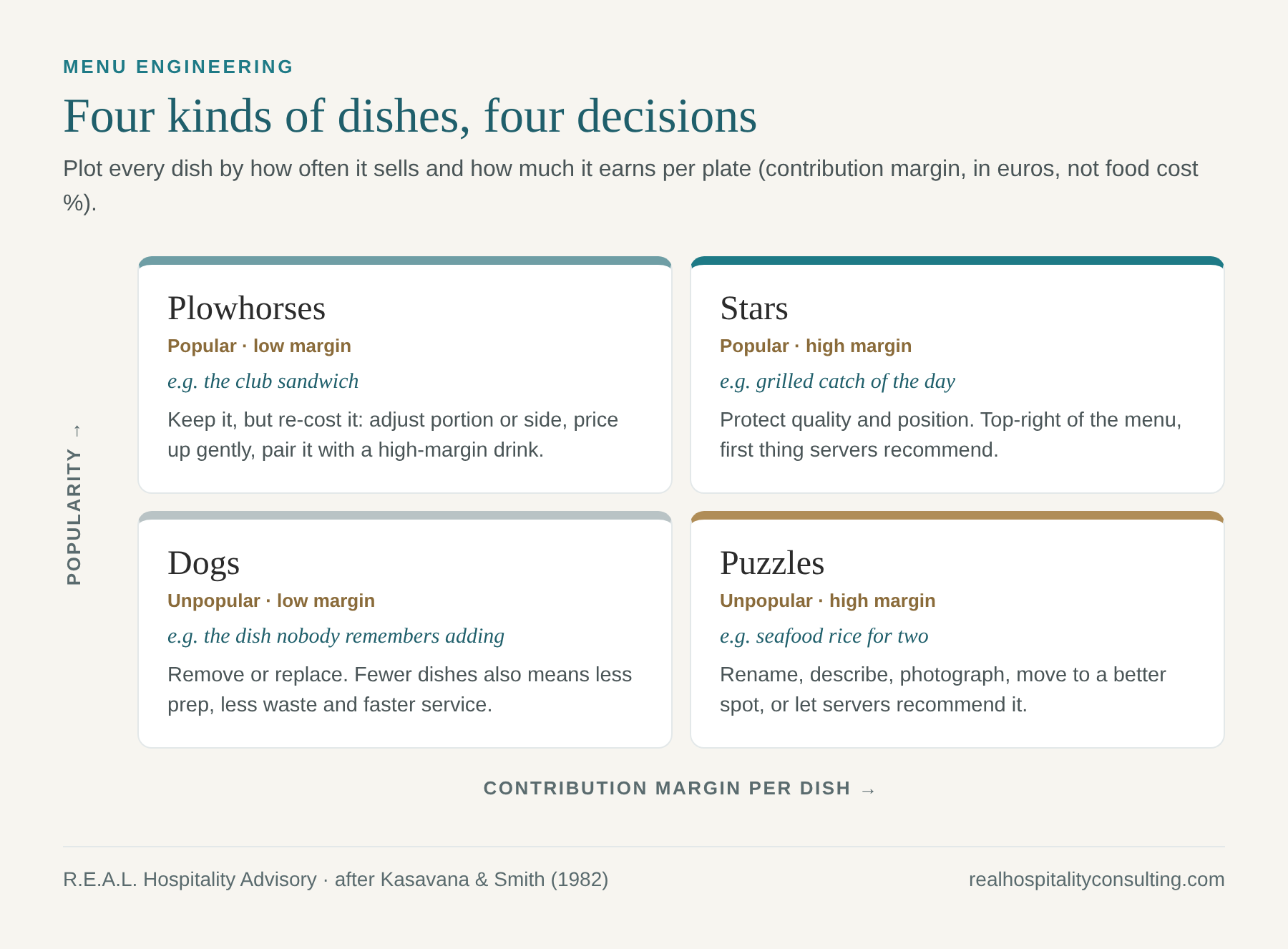
The most common mistake we see is judging dishes on food cost percentage alone. A steak at 38% food cost may earn €19 per plate, while a pasta at 22% earns €11. The steak looks worse on the percentage and is far better for the business. Always work in contribution margin in euros: selling price minus ingredient cost.
Two practical tips:
- Review the menu with real sales data at the end of each season, not just when the chef wants a change.
- A shorter menu is usually a more profitable one. Removing the dogs reduces waste and speeds up the kitchen, which also helps your seat hours.
4. Price by demand, with value on the quiet days
Hotels change room rates daily; restaurant prices barely move. You do not need to change menu prices every night, but you can price by demand in ways guests understand:
- Peak times: sunset or prime-time terrace tables, set menus on the busiest nights, and minimum spends for the best tables at events
- Quiet times: an early-evening menu, a midweek "wine and dine" offer, or a set lunch for locals and nearby businesses
- Packages: dinner included in a room package on the nights the restaurant needs help, not on the nights it is already full
The rule is the same as for rooms: protect your price on high-demand nights and create value, not discounts, to fill the quiet ones.
5. Turn your service team into a sales team
Your servers have more influence on revenue than any menu or price. Good upselling is not pushy; it is recommending the right thing to the right guest. Training makes the difference:
- A five-minute pre-shift briefing: today's forecast, specials, the stars to recommend and one dish to push from the puzzles
- Practical pairing knowledge for wines, cocktails and desserts, ideally from tasting
- Reading the table: a business lunch, a family and a couple celebrating need different suggestions
- Sharing results: average check and dessert or wine sales by server, celebrated rather than policed
Bring F&B into the commercial meeting
All of this works best when food and beverage is part of the hotel's weekly commercial meeting, not a separate world. Groups should be priced on their total value, including dinners and meeting packages. Marketing should promote the restaurant on its need nights. And revenue's occupancy forecast should feed the restaurant's cover forecast automatically. We wrote about how to run that meeting in One Commercial Team.
Your F&B checklist for this summer
- Calculate RevPASH by day and meal period for last summer.
- Build a weekly cover forecast using the hotel's occupancy on the books.
- Map your menu into stars, plowhorses, puzzles and dogs using contribution margin.
- Introduce one value offer for your quietest service of the week.
- Start a five-minute pre-shift briefing with the forecast and the dishes to recommend.
How we can help
Julio has opened and run restaurants and multi-site food and beverage operations, and trains service teams as a lecturer. If your outlets are busy but not as profitable as they should be, book a free discovery call and we will start with your own numbers.