· 7 min read · Julia Krebs
Direct Bookings in the Age of AI Search: What Independent Hotels Should Do in 2027

Every January we have the same conversation with hotel owners: how do we get more guests to book with us directly? In 2027 the question has a new twist. More and more travellers start their search by asking an AI assistant instead of typing into a search box, and some of those assistants can now complete the booking themselves.
That changes where the fight for the direct booking happens. It does not change what wins it: a clear reason to book with you, a website that converts, and knowing exactly what each channel really costs you.
Where direct bookings stand today
Direct is still the largest channel in Europe. HOTREC's 2026 European Hotel Distribution Study (covering 2025) puts direct bookings at roughly half or more of all hotel bookings, while online travel agencies account for around 28–30%. Within that OTA share, Booking.com alone holds about two-thirds.
So the problem is not that OTAs are taking everything. It is that the OTA share is concentrated and expensive, and every booking you move from an OTA to your own website goes almost straight to the bottom line.
What changed in 2026: AI search became bookable
- ChatGPT: in October 2025 Booking.com and Expedia launched apps inside ChatGPT, so users can search and compare hotels without leaving the chat (initially outside the EU). Large chains, Accor among them, followed with their own apps in early 2026.
- Google: on 27 August 2026 Google started letting US travellers find, compare and book hotels entirely inside AI Mode. The ten launch partners were all large OTAs or major chains. Independent hotels were not on the list.
For now this is mostly a US story, but it shows the direction. The new risk for independent hotels is being visible but not bookable: the AI recommends your hotel, and the booking button belongs to someone else.
1. Check how AI assistants describe your hotel
Before changing anything, test. Ask ChatGPT, Gemini, Google AI Mode and Perplexity the questions your guests would ask, such as "a quiet boutique hotel near the beach in Marbella for a couple". Note whether you appear, what is said about you, and which booking link is offered.
- Keep your facts identical everywhere: website, Google Business Profile, OTA listings and review sites. AI tools combine all of them, and contradictions cost you.
- Add structured data (schema.org markup for your hotel, rooms and FAQs) and make sure pages load fast on mobile.
- Answer real guest questions in plain language on your own website: parking, distance to the beach, early check-in, pets, accessibility.
- Keep reviews recent and reply to them. They are part of what AI assistants read.
2. Give guests a real reason to book direct
"Best rate guaranteed" is not a reason any more; guests assume it. A concrete benefit is. Value-adds protect your rate integrity far better than discounts:
- Early check-in or late check-out, confirmed according to occupancy
- A welcome drink, parking or a food and beverage credit
- Priority for room upgrades
- Flexible cancellation that the OTA rate does not offer
Show these benefits on the booking engine itself, next to the price, not only on the homepage.
3. Remove friction from your booking engine
Every extra step loses guests. Book your own hotel on your phone once a month and time it. Show the total price early, keep the steps to a minimum, offer the payment methods your source markets actually use, and track where guests abandon. A good AI answer that leads to a slow, confusing booking page simply hands the booking to an OTA.
4. Be present on metasearch
Google's free booking links let your own website appear next to the OTAs on Google, at no cost per click. Connect them through your booking engine or channel manager if you have not done so yet. Then use paid Google Hotel Ads selectively, in need periods identified by your revenue forecast, rather than all year round.
5. Turn the guests you already have into direct repeat guests
Your cheapest next booking is a past guest. With the guest's consent, capture email addresses at check-in, including from OTA bookings, and use your CRM for:
- Pre-arrival messages with relevant upsells
- A personal post-stay offer to book direct next time
- Simple recognition for returning guests, without a complicated loyalty programme
6. Know what each channel really costs you
This is where most independent hotels are flying blind. Revenue by channel is easy to see; profit by channel is not. And direct bookings are not free either: your website, booking engine, ads, card fees and reservations team all cost money.
To make this visible, I built a simple Booking Cost Calculator. You enter one year of bookings per channel (number of bookings, average stay, rate, commission, fees and fixed costs) and it shows what you really pay to win each booking. This is the example hotel we use: 40 rooms at about 70% occupancy.
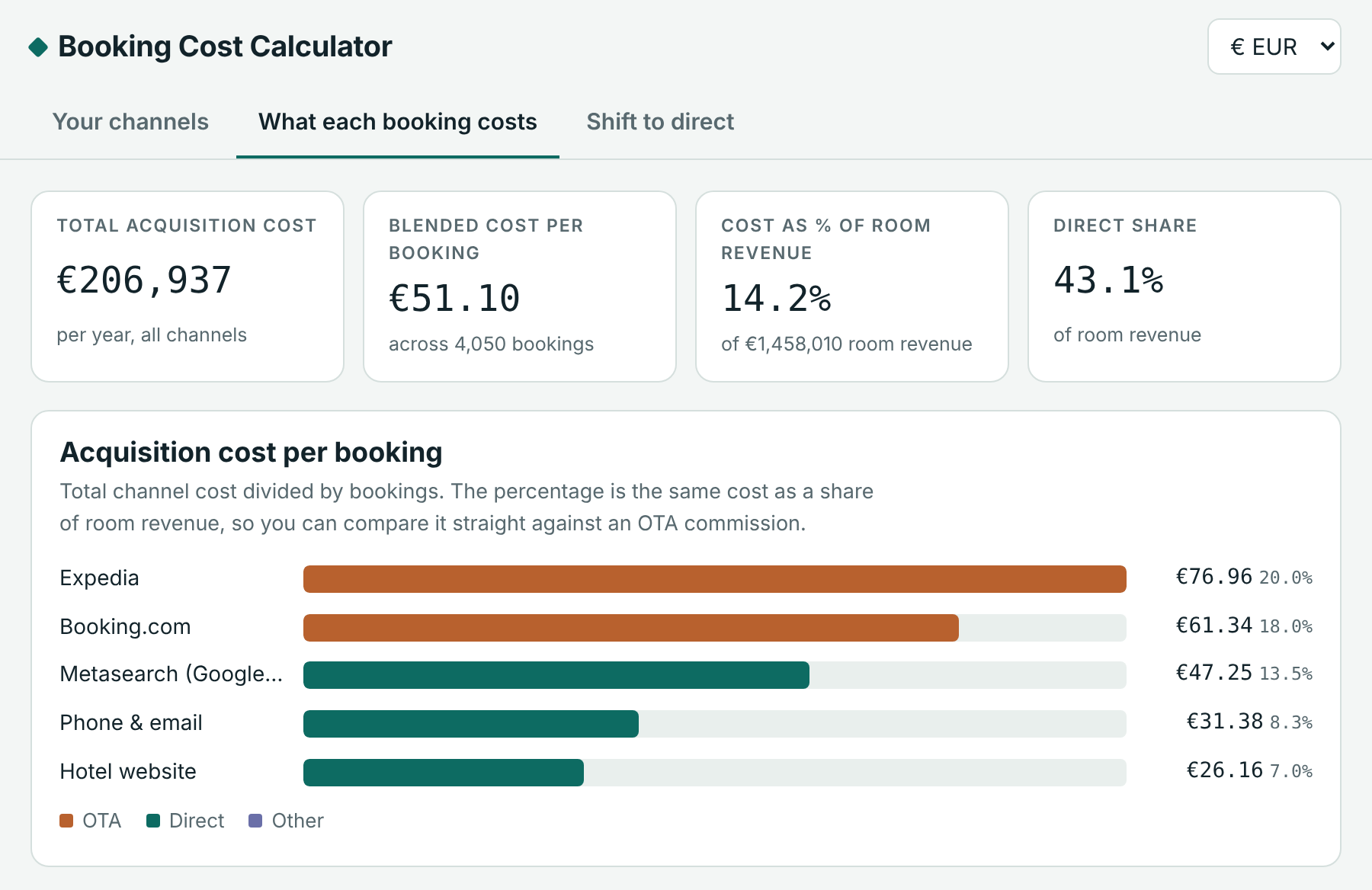
Three things stand out for this example hotel:
- An Expedia booking costs €76.96 to win; a booking on the hotel's own website costs €26.16, even after counting the website, booking engine and staff time.
- The hotel spends €206,937 a year, 14.2% of its room revenue, just to acquire guests. That number rarely appears on a P&L in one line.
- Moving only 10% of OTA bookings to the website (235 bookings a year), even with €15 of extra marketing per booking, keeps an extra €10,662 a year for the same rooms.
Every hotel's numbers are different, which is exactly the point: until you calculate yours, you are negotiating with OTAs and setting marketing budgets blind.
The figures to track every month:
- Direct share of room revenue
- Net average daily rate by channel, after commission and fees
- Total cost of acquisition per booking, by channel
- Booking engine conversion and abandonment rate, by device
Your direct booking checklist for 2027
- Ask four AI assistants about your hotel and record what they say and where they send the guest.
- Align your facts across your website, Google Business Profile and OTA listings.
- Add a clear list of direct booking benefits to your booking engine.
- Book your own hotel on a phone and fix the three biggest frictions.
- Activate Google free booking links.
- Start collecting guest emails at check-in, with consent.
- Calculate your cost of acquisition per booking for every channel.
How we can help
Not sure what your channels really cost you? Our free channel cost analysis shows your net revenue per channel and where your quickest direct booking wins are. Request yours here, or book a discovery call with Julia.
Sources
- HOTREC 2026 study figures, as quoted in "Booking.com says Europe's hotels don't depend on it" (Hospitality Net, Oct 2026)
- HOTREC 2026 study figures, as quoted in "Hotel distribution is not a zero-sum game" (Hospitality Net, Sep 2026)
- ChatGPT wird zur Buchungsplattform (Tageskarte, Oct 2025)
- Accor launches app in ChatGPT (Skift, Jan 2026)
- Google just started booking hotels inside AI; independent hotels were not on the list (Hotel-Online, Sep 2026)