· 5 min read · Julia Krebs
Building a Commercial Culture: Training Every Team to Think Like an Owner
November is when hotels write next year's budget, and with it the training plan. It is also the moment to ask an uncomfortable question: if your front desk agent, your restaurant supervisor or your reservations team were asked how the hotel makes money, what would they say?
Over this year we have written about direct bookings, commercial meetings, restaurant revenue and group pricing. All of them depend on one thing we have not yet talked about: people. A pricing strategy fails at a check-in desk where nobody mentions the upgrade. A carefully forecast need period stays empty when reservations quotes the same rate as in August. The best group evaluation sheet is useless if sales never opens it.
That is what we mean by commercial culture: every team understands how the hotel earns its money, and makes small, daily decisions that support it.
Why this matters now
The HSMAI Foundation's 2025 State of Talent Report ranks "retention through upskilling, reskilling and upward mobility" among the top talent trends in hotel sales, marketing and revenue, alongside the rise of AI and cross-functional teamwork in the commercial function. In other words, training is no longer only about performance. It is one of the main reasons good people stay.
For independent hotels, this is an advantage. You cannot match a large chain's salary scales or corporate academies, but you can offer something they often cannot: short, practical training, close to the business, where people see the result of what they learn within a week.
1. Teach everyone the basics of how the hotel earns money
Every team member, not just managers, should be able to explain in their own words:
- What occupancy, average daily rate and RevPAR mean, and which matters more on a busy night
- Why a direct booking is worth more to the hotel than the same booking through an online travel agency
- What a need period is, and which dates are coming up
- Which offers and packages are active this month
This does not need a classroom. A 20-minute session in a department meeting, repeated each quarter, is enough. What matters is that people hear it from their own managers, with the hotel's own numbers.
2. Give each department one commercial habit
The mistake many hotels make is to ask everyone to "be more commercial". That means nothing on a busy Monday. It works far better to give each team one clear habit, and one number that shows whether it is happening.
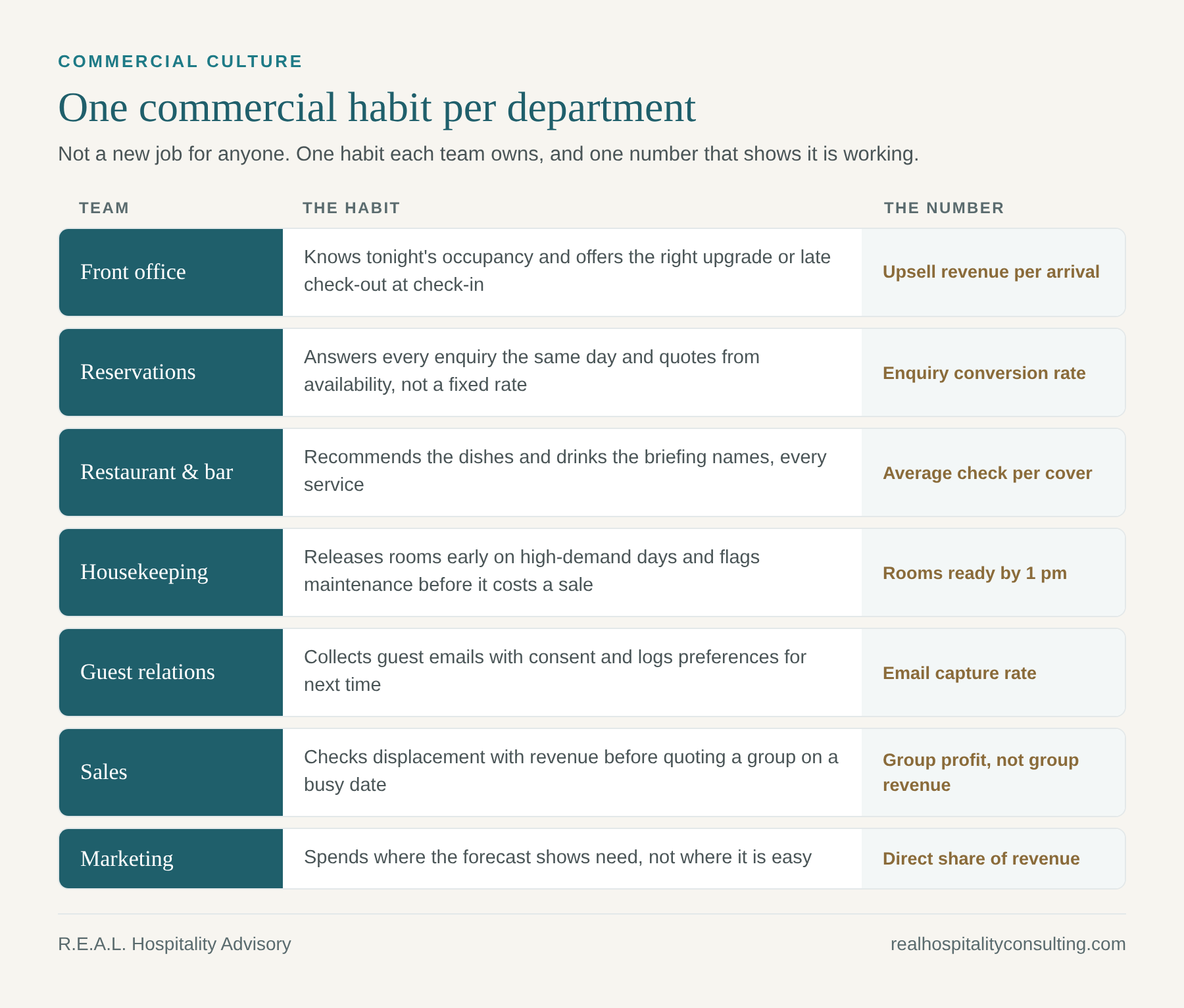
Choose the habits with the team, not for them. People defend what they helped design.
3. Share the numbers, every week
People cannot act on numbers they never see. Put a one-page summary on the staff notice board or in the team chat every week: occupancy for the coming days, the need periods, last week's upsell revenue and direct share, and one thank-you for a commercial win. It takes ten minutes to prepare and changes the conversation in the staff canteen.
4. Train service and selling as one skill
Upselling often fails because staff feel it is pushy. It is not, when it starts from the guest. A guest arriving after a long journey may love a quieter room with a bath; a couple celebrating may welcome a bottle of cava in the room. Training should teach people to read the guest first and recommend second.
This is the heart of what we call service emotional intelligence: noticing what a guest needs, often before they say it, and turning that into a better stay and better revenue at the same time. In our experience it is the training that staff enjoy most, because it makes their work feel more like hospitality and less like selling.
5. Give people room to decide
A commercial culture needs some freedom. Agree clear limits, then trust the team within them:
- Front desk can offer an upgrade or late check-out up to an agreed value without asking
- Restaurant supervisors can create a daily special to move a slow ingredient
- Reservations can offer an agreed value-add to close a booking in a need period
- Any team member can propose a revenue idea in the weekly commercial meeting
6. Celebrate commercial wins
Recognition costs almost nothing. A record direct-booking week, a server whose wine sales doubled, a receptionist whose upgrades paid for a month of training: name them, thank them, and tell the story. Culture is built from the behaviour you notice.
A simple training year
You do not need a large budget. A plan like this, with one theme per quarter, fits around operations:
- January to March: the basics. How the hotel makes money, the key numbers, and each department's commercial habit.
- April to June: guest-centred selling. Service emotional intelligence, upselling and recommendations before the summer peak.
- July to September: systems. Getting more from the tools you already pay for: the property management system, guest profiles and the booking engine.
- October to December: review and reward. What worked, which numbers moved, who made the difference, and what to change for next year.
Your checklist for next year's training plan
- Ask five team members how the hotel makes money, and listen to the answers.
- Agree one commercial habit and one number per department.
- Start a weekly one-page numbers summary for all staff.
- Write down what each team can decide without asking.
- Put four short training themes in next year's calendar and budget.
- Choose how you will recognise commercial wins, and start this month.
How we can help
We design and run practical commercial and service training for hotel and restaurant teams, from revenue basics for the whole hotel to service emotional intelligence for front-line staff. Both of us teach hospitality at university level, and we bring that structure into the hotel, adapted to your team and your numbers. Book a free discovery call to plan your 2028 training year.